
Public Charge
a new play which will help you grieve what we've lost.

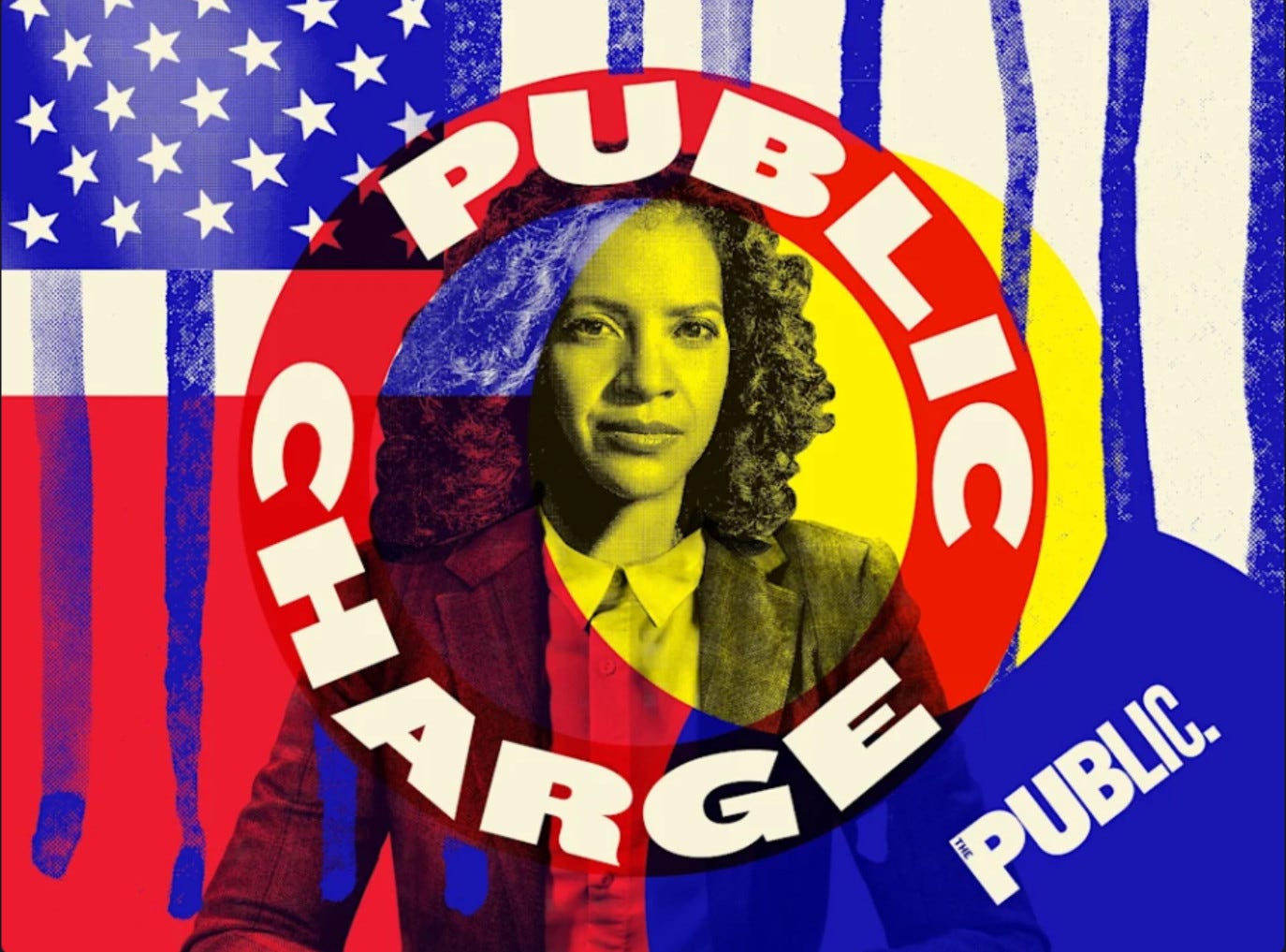
I attended a preview performance of a new play called “Public Charge.” The name is taken from the status that immigrants must prove they won’t become if they are granted permission to be in the United States. That is, they won’t just become a “Public Charge,” the bureaucratic term for an unproductive parasite relying upon the US public assistance system for income.
The play opens with the protagonist, Julisa Reynoso (co-author) as a six year old Dominican national enduring the peppered leading questions of an authoritarian immigration bureaucrat who ends up, decades later, becoming her assistant. The adult with Julissa protests the harsh questioning; this tin-horn bureaucrat clearly relishes the opportunity to remind them both that the US can’t afford to allow those in who will just end up as a public charge. He spits the term out of his mouth.
Julissa next encounters this bureaucrat decades later after graduation from Harvard law as she applies for a position with the Obama-era US State Department. Age has not tempered him from being the same prick to her about her progressive political views; the narrative diverts to remind the audience that her Uncle who runs the Bodega in her Bronx neighborhood also shares these views, particularly about Cuba. As an attorney and public servant, she now appreciates his years of professional expertise and knowledge in the region; she shows him a grudging respect despite his persistently abrasive self-righteousness.
The story advances to Julissa’s appointment as a diplomatic official in the Caribbean by Secretary of State Hillary Clinton. This prickly bureaucrat is assigned to be Julissa’s subject matter expert.
These plot twists are illuminated during Julissa’s often difficult interactions with another professional diplomat, a black woman with a direct no-nonsense manner that still manages to respect diplomatic norms while communicating that she will kick your stupid ass if you don’t listen.
The play is nestled around the story of an American USAID worker who was jailed and imprisoned by the Cuban government as a spy. Whether or not he actually was a spy is left in the hazy middle-ground in which overseas work operates. One person’s spy is another person’s humanitarian worker.
Whatever the truth is, the USAID worker ends up being used as leverage to secure the release of five Cubans in US prisons for espionage. I won’t offer any spoilers in this review, but despite a satisfying resolution, things don’t turn out as well as they could have.
What struck me most about seeing this play was my own grief. The US government depicted in this production, a collection of dedicated professionals trying to deal with real situations in the world, public servants interested in helping families fractured by politics find ways to hug each other anyway, is gone. MAGA killed it. DOGE fired all of these people.
I think that’s why the Public Theater, and this excellent ensemble cast, decided to push this production forward to staging and premier. It is a love letter to good government, a bright red rose left on its grave.
The staging was minimal. Raised platforms only. This was a performance of words and ideas. One hour, forty minutes, no intermission.
I was riveted from the opening line to bows of the cast at the end. This was excellence in theater, and still in previews.
I was shocked, honestly, by how good it was. I really enjoyed it.